

After an accident or loss, negotiating an insurance settlement is usually the last thing you want to deal with.
But here’s the issue: Legal sources estimate that about 85% of initial insurance settlement offers undervalue claims.
So, if you want to get closer to what you’re actually owed, you have to negotiate. It’s how you make sure medical bills, repairs, lost income, and future costs aren’t brushed aside for the sake of a quick payout.
However, the insurance company negotiates claims for a living, so its adjusters have done this hundreds or thousands of times. You probably haven’t.
That’s why this guide lays out eight practical tips on how to negotiate an insurance settlement, so you can push back with facts and avoid accepting less than you should.
Key takeaways
- Know what your claim is actually worth before you negotiate
You can’t negotiate effectively without a clear settlement range. Factor in all losses, not just immediate bills, and keep your internal numbers private so they guide your decisions without giving the insurer leverage. - Expect the first offer to be low, and respond strategically
Initial offers are designed to close claims quickly, not fairly. Slow the process down, counter with facts, and use comparable settlements to demonstrate your understanding of how claims are valued. - Force the insurer to justify their numbers in writing
Asking for a detailed breakdown shifts the discussion from opinion to proof. Once insurers have to explain what they included, excluded, or discounted, weak offers tend to move. - Documentation and communication are your leverage
Organized records and calm, disciplined communication make your claim harder to dismiss or delay. Say less than you think you need to, stick to facts, and keep everything on the record. - Not every payout requires negotiation, and that’s where Settlemate helps
Some situations are better handled collectively through class actions or refunds rather than individual negotiation. Settlemate helps you identify whether your situation is already covered by an existing settlement and finds other money you are owed, without paperwork or back-and-forth, so you can focus on negotiations that actually matter.
1. Know your settlement range upfront
One of the most important facts you’ll need during the negotiation process is the value of your claim. This is what allows you to judge whether an offer is reasonable or too low.
When calculating how much your claim is actually worth, you need to account for every loss tied to the incident, not just the obvious bills. This includes:
- Medical treatment, both current and future
- Property damage or repair costs
- Lost income and reduced earning capacity
- Pain, suffering, and emotional distress
- Long-term impacts like disability or scarring
- Out-of-pocket costs related to recovery
You may need to adjust this number as negotiations unfold if new information surfaces or the insurer raises valid issues.
Whatever the case, don’t reveal your internal numbers to the adjuster. They exist to anchor your decisions, not to give the insurer leverage.
2. Expect the first number to be low
Given how often initial insurance offers undervalue claims, you shouldn’t accept the first settlement offer. If you do, you risk locking in tens of thousands less than your claim is worth.
In one analysis, people who negotiated their settlements received, on average, about $30,700 more than those who accepted the first offer.
That gap isn’t accidental.
First offers are designed to close claims quickly and cheaply. Insurers know many people are under financial pressure and tempted to take whatever shows up first.
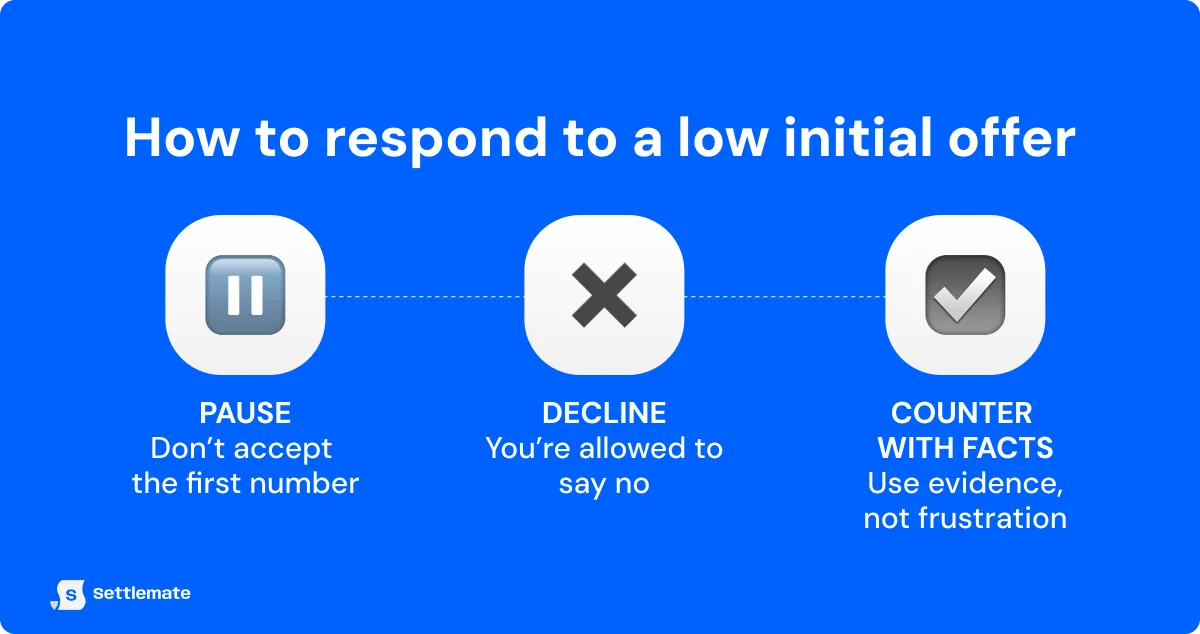
What you should do instead is slow the process down.
Decline the offer and respond with a counter. However, don’t inflate the number as a response to a low or frustrating opening offer; a fact-based counter keeps the negotiation productive and credible.
The counteroffer can also be based on comparable settlements since insurers rely on precedent when valuing claims.
If similar cases have resulted in higher payouts, referencing those outcomes helps justify your position and signals that you understand how claims are evaluated.
3. Ask for a detailed breakdown of the offer
Another effective way to respond to a low settlement offer is to make the insurer explain it.
Instead of lowering your number or arguing in circles, ask for a written breakdown showing exactly how they calculated the offer.
Specifically, ask the adjuster to outline:
- Which damages they included
- Which costs they excluded or discounted
- How they valued medical treatment, lost income, and non-economic losses
- Which assumptions they relied on to justify the number
Once you have that breakdown, respond point by point.
If the insurer left something out or undervalued a cost, point to the documentation and let the evidence do the work.
If one of their points is valid, you can adjust slightly, but only after they’ve justified their position in writing.
Once insurers have to defend their numbers on paper, low offers tend to move.
4. Document everything, and keep it organized
There’s a reason many of the tips in this guide on how to negotiate an insurance settlement rely on the same thing: documentation.
Clear, consistent documentation makes your claim harder to dismiss or delay and more expensive for the insurer to fight.
The table below outlines the most important types of documentation, how to get them, and why they matter during negotiations.
The more organized your documentation is, the less room the insurer has to argue, and the stronger your negotiating position becomes. Here are some helpful practices:
- Use a single digital folder for the claim, with subfolders for different types of evidence.
- Name files clearly with dates and descriptions (e.g., 2025-03-12_ER_bill.pdf).
- Keep a running list of expenses and key events so nothing gets overlooked.
This approach allows you to pull up any document in seconds, which, in turn, means you’re negotiating from a position of control.
5. Don’t let the insurer rush the clock
Insurers often try to rush negotiations, sometimes even calling you hours after an accident or loss.
This approach allows them to:
- Settle before all injuries or damages are identified
- Minimize payouts tied to ongoing or future treatment
- Close the claim before you’ve gathered documentation
That’s why you shouldn’t play along.
You need time to get proper medical care, follow treatment plans, and understand how the incident actually affects you. Gaps in treatment or unreported injuries give insurers an easy excuse to discount or deny parts of your claim.
Remember that you can always negotiate later, but you can’t undo a rushed settlement.
6. Control the conversation
With all the delays, vague responses, and low offers, negotiating an insurance claim can test your patience. Whatever the insurer throws at you, you should aim to stay calm, clear, and consistent from start to finish.
Adjusters are trained to listen closely, document everything, and use loose or emotional statements against you.
Keep in mind that staying professional doesn’t mean being passive—it means applying steady pressure without giving them any ammunition.
The table below outlines what to do and what to avoid when communicating with the insurer during negotiations.
One more rule worth remembering is saying less than you think you need to.
Casual comments like “It’s not as bad as it seemed at first” or chatting about travel, hobbies, or prior injuries can be misinterpreted or used to downplay your claim.
Answer what’s asked, stick to the basics, and save details for written submissions backed by records.
7. Know when to bring in outside help
In some cases, there’s only so much you can achieve on your own. Negotiations tend to stall when the claim is high-value, the facts are disputed, or the insurer simply stops engaging in good faith.
You’ve usually hit that point when:
- The insurer keeps delaying without explanation
- Offers don’t improve despite strong documentation
- Liability is contested, or the injuries are long-term
- The adjuster starts pressuring you to settle “as is”
If this happens, the best course of action is to escalate.
Consulting an attorney or experienced claims professional changes the dynamic immediately.
Insurers know when they’re dealing with someone who understands valuation, evidence, and legal risk, and they negotiate differently as a result.
8. Recognize when negotiating isn’t worth it
Negotiating isn’t always the right move. In some insurance-related situations, pursuing a claim individually offers little leverage, and the time and effort required simply aren’t worth it.
This tends to happen when:
- The harm is widespread and standardized, not unique to you
- The insurer or company applies the same rules to everyone
- Individual damages are real but relatively small on their own
- There’s no meaningful room to negotiate terms or amounts
This is where it makes more sense to join a class action lawsuit rather than pursue individual negotiations.
Class actions address these issues collectively, with predefined eligibility and standardized payouts.
If individual negotiation won’t change the outcome, becoming a class member can be a more efficient way to recover what you’re owed and move on.
Settlemate: Not every payout requires negotiation

If you’re researching how to negotiate an insurance settlement, you’re probably dealing with a specific claim right now. But insurance negotiations are just one category of situations where you’re owed money.
Data breach settlements, airline refunds, food recalls, and post-purchase price adjustments are just some of the cases where consumers routinely qualify for payouts without realizing it.
The best part is that, with the right tool, none of these require lengthy back-and-forth, legal research, or follow-ups.
That’s where Settlemate comes in.
Settlemate is a consumer app that automatically helps people find and claim money they’re legally owed. It handles the tedious parts so you don’t have to, including:
- Scanning your inbox and receipts to detect claims you qualify for
- Matching you to active class action settlements and refund opportunities
- Auto-filling and submitting claim forms (and mailing them when required)
- Tracking deadlines, claim status, and payouts in one place
This means that Settlemate can help you determine whether your current situation is already covered by an existing settlement and surface other payouts you’d otherwise miss.
Download Settlemate for iOS or Android and let it work quietly in the background while you focus on more complex negotiations.